Communism in Kerala
The God of Small ThingsCommunism in Kerala is portrayed not as a straightforward class revolution but as a political force that gained ground by adapting to a society structured by caste, religion, and inherited privilege. Its electoral advances brought reformist promises and militant challenges into conflict, while the 1969 labor march makes visible both the movement’s capacity to organize workers and the limits of political change when older hierarchies remain intact.
Origins and Local Adaptation
The novel treats the Communist Party’s unusual success in Kerala as a question without a complete answer. Chacko himself cannot explain why it prospered there more than almost anywhere else in India, except perhaps in West Bengal. One theory attributes this success to the state’s large Christian population: Syrian Christians made up twenty percent of Kerala’s population and believed themselves descended from Brahmins converted by St. Thomas the Apostle. On this account, Marxism could resemble Christianity in structure, replacing God with Marx, Satan with the bourgeoisie, Heaven with a classless society, and the Church with the Party. The analogy offered a familiar form for the promise of political transformation, but it did not explain which groups would embrace that transformation.
Indeed, the theory runs up against the social position of many Syrian Christians. They were generally wealthy landowners and feudal employers, including owners of pickle factories, and regarded communism as a threat; they had traditionally voted for the Congress Party. The novel therefore rejects a simple equation between religious culture and Communist support. Its account instead emphasizes how political affiliation and economic interest could pull in opposite directions.
The movement’s “real secret,” as the narration describes it, was its gradual and reformist approach. Communism entered a caste-ridden, highly traditional community without openly challenging its inherited values. Marxists worked within communal divisions rather than appearing to confront them, offering what the novel calls a “cocktail revolution”: Eastern Marxism combined with orthodox Hinduism and democracy. This adaptation helped make the movement politically effective, but it also points to a limit: gaining influence did not necessarily mean dismantling the divisions through which local society was organized.
The First Communist Government and Its Reversal
Chacko was not a card-holding party member, but he had become a committed supporter early in life. As an undergraduate at Delhi University, he experienced the euphoria of 1957, when the Communists won the State Assembly elections and Jawaharlal Nehru invited them to form a government. Chacko admired Comrade E. M. S. Namboodiripad, the Brahmin Marxist who became Chief Minister of the world’s first democratically elected Communist government. His attachment to the movement thus began not as formal membership but as political conviction and admiration for a leader.
Once in office, the Communists faced the contradiction of having to govern while also pursuing revolution. Namboodiripad’s theory of a peaceful transition set out plans for land reform and for changing the operation of the police and judiciary, as well as resisting the Congress government at the center. Chacko studied the treatise with the intensity of an adolescent admirer. The political project mattered to him as an ambitious attempt to translate revolutionary aims into governmental action.
That peaceful transition soon faltered. Over the next two years, political conflict fueled by the Congress Party and the Church slid toward anarchy. After Chacko completed his BA and left for Oxford, Kerala was described as approaching civil war. Nehru dismissed the Communist government and called fresh elections, after which the Congress Party returned to power. The episode establishes a recurring tension in the novel’s political history: electoral victory could open the door to reform, but it did not secure the government against organized opposition or political crisis.
In 1967, almost ten years after the first Communist victory, Namboodiripad’s party returned to office as part of a coalition. By then the movement had divided into the Communist Party of India and the Communist Party of India (Marxist). During this second term, Namboodiripad pursued the peaceful transition more cautiously. The Chinese Communist Party condemned this approach as parliamentary revisionism, accusing the government of easing people’s conditions in a way that blunted revolutionary consciousness. The dispute sets reform and revolution against one another: measures that improve people’s immediate circumstances could be treated by militants as obstacles to a more radical transformation.
Parliamentary Politics and Militancy
The split between parliamentary strategy and armed struggle sharpened with the rise of the Naxalites. Backed by the Chinese Communist Party, this militant faction organized peasants into fighting groups, seized land, expelled landowners, and established People’s Courts to try those it classified as class enemies. The movement spread beyond its origins in Naxalbari, a village in Bengal, and generated fear among the propertied classes. Namboodiripad expelled the Naxalites from his party and continued to channel political anger into parliamentary activity.
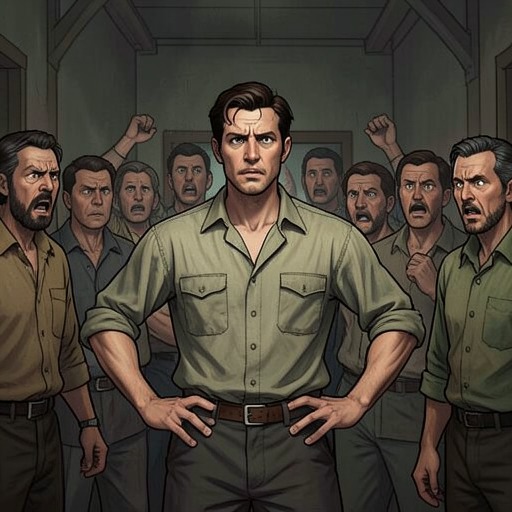
The novel connects this national and ideological conflict to a particular local demonstration. The march that surged around Pappachi’s Plymouth on a December day was organized by the Travancore-Cochin Marxist Labour Union. Its comrades in Trivandrum planned to march to the Secretariat and present a Charter of People’s Demands to Namboodiripad. The narration likens the march to an orchestra petitioning its conductor: organized labor addresses a government led by its own political movement, asking it to act on grievances that remain immediate and material.
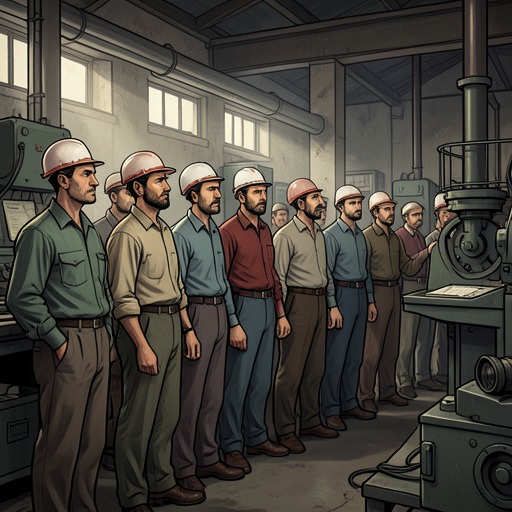
The demands specify the conditions workers wanted changed. Paddy workers, who labored eleven and a half hours a day, from seven in the morning until half past six in the evening, sought permission for a one-hour lunch break. The march also called for women’s daily wages to rise from one rupee and twenty-five paisa to three rupees, and men’s from two rupees and fifty paisa to four rupees and fifty paisa. These figures give the movement’s claims a practical measure: political struggle concerned both the length of the working day and the unequal, inadequate pay workers received.
The charter also addressed caste directly. Marchers demanded that Untouchables no longer be called by caste names such as Achoo Parayan, Kelan Paravan, and Kuttan Pulayan, but simply as Achoo, Kelan, and Kuttan. The demand links labor organization to the everyday language used to mark social status. The march included party workers, students, laborers, Touchables, and Untouchables; its participants carried what the narration describes as accumulated anger, now sharpened by a newer, Naxalite edge. Their coalition did not erase social divisions, but it brought workers across those divisions into a public political demonstration.
Caste, Privilege, and the Limits of Reform
The novel places this political mobilization beside the history of caste exclusion within religious and economic institutions. Under British rule in Malabar, some Paravans, Pelayas, and Pulayas—including Velutha’s grandfather, Kelan—converted to Christianity and joined the Anglican Church in an effort to escape Untouchability. Conversion brought limited food and money, but did not end segregation: converts were assigned separate churches, services, and priests, including a separate Pariah Bishop. After Independence, their formal status as Christians meant that they were officially treated as casteless and consequently excluded from government benefits such as job reservations and low-interest bank loans. The episode reveals how a change in religious affiliation could leave the underlying social disadvantage in place, while also depriving people of recognition as members of the oppressed caste categories that might have qualified them for assistance.
The narrative’s account of the march’s demands makes that history politically present. Asking that people not be addressed by caste names is more than a request for courtesy: it contests a system that makes caste legible and enforceable through ordinary speech. Yet the movement’s reformist strategy had to operate within the same deeply traditional society it sought to change. Communism could gather a mixed crowd and put wages, hours, and caste address on a public platform, while the continuing presence of exclusion showed how far those demands remained from a settled transformation.
The limits are also visible in the family’s response to gender and class hierarchy. Baby Kochamma accepts the notion of “Men’s Needs,” and she and Mammachi see no contradiction between Chacko’s Marxist views and his feudal sexual privilege. They fear the Naxalites because of reports that militants might compel men from respectable families to marry servant women they had made pregnant, yet do not anticipate that the family’s public reputation will be undone by events arising from a different social boundary. The contrast does not make the family’s private arrangements equivalent to party politics; it shows instead that Communist allegiance could coexist with assumptions of male and class privilege at home.
Political Power and the Novel’s Wider Critique
The later landscape of the Meenachal River extends the novel’s examination of political choices into development and environmental cost. A saltwater barrage was built downstream in exchange for votes from the influential paddy-farmer lobby. By regulating saltwater from the backwaters connected to the Arabian Sea, it enabled two rice harvests a year instead of one, but the narrative measures the increased yield against the price paid by the river. The arrangement makes political benefit visible as a bargain: production gains accrue through an intervention whose costs are borne by the shared environment.
Elsewhere along the river, the narrative depicts exposed mud banks beside shanty settlements, waste entering the water, and factory effluent used for washing and bathing. The History House can no longer be approached from the river; hotel guests arrive from Cochin by speedboat, which leaves a film of gasoline behind. Tourism brochures still advertise Kerala as God’s Own Country, while the resort’s operators treat pollution and poverty as conditions guests can be trained to tolerate through discipline and air-conditioning. These details do not assign every development decision directly to Communist policy. Rather, they widen the political setting in which the movement’s promises are assessed: agricultural productivity, tourism, and employment can be celebrated while ecological damage and unequal exposure remain part of the cost.
Through Chacko’s admiration, the government’s rise and dismissal, the party’s later division, and the labor march’s specific claims, Communism in Kerala becomes a test of what political change can accomplish when it works through established institutions and social divisions. It can make reform a governing project, organize workers, and put caste discrimination into the language of public demands. But the novel repeatedly places those advances against durable hierarchies—in landholding, caste status, gender, and the family—and against consequences that are not evenly borne. Its political history is therefore neither a simple tale of revolution fulfilled nor one of reform without effect: it is a record of gains contested, compromises made, and structural inequalities continuing to shape whose interests count.